
Overview of the German healthcare system
The German healthcare system provides high-quality medical services. To utilize it, you’ll need to have health insurance. Health insurance covers the costs of medical treatments and therapies, medications, and hospital stays. For some services, the insurance members themselves pay a small portion of the costs, i.e., a “co-pay.”
You yourself get to decide which health insurance fund you want to join, and there are many of them. Most people in Germany have public health insurance (also referred to as “statutory health insurance”). If your income is above a certain level, you can choose private health insurance instead.
The National Association of Statutory Health Insurance Funds – an organization which represents the interests of all the statutory health insurance funds in Germany – provides and maintains an overview of all statutory health insurance funds.
Information about the German healthcare system
How is the German healthcare system structured? And, how do you find the right health insurer? Find answers to these questions and more here.

Health for all
The Guide Health for all shows you how to navigate the German healthcare system. This brochure is available in 15 languages.

Full information on health insurance
How do I get health insurance and what benefits does it provide? The Make it in Germany portal offers answers.
Urgent care
If you get sick when your doctor’s practice is closed and need medical attention urgently, contact the emergency doctor service or stand-by medical service. You can find out which doctor’s practice near you is on stand-by by calling the toll-free number 116 117, available all across Germany.
In emergencies like major accidents or a suspected stroke or heart attack, contact the emergency services immediately. They’re available across Germany by calling 112.
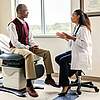
Sickness and urgent care
If you’re sick, you should visit a general medical practice first. There, a general practitioner or primary care practitioner (Hausarzt) will examine you and, if necessary, refer you to a specialist. You can look for doctor’s practices near you on the website of the National Association of Statutory Health Insurance Physicians. This website will also show you doctors who speak your native language.
Money and banks
From your own bank account to German payment modalities, here you’ll find everything you need know about the topic of money in Germany.
How to open a bank account
Before you decide on a bank and a bank account, you should ideally compare multiple banks. Many banks charge fees for things such as account management or international transfers, and these fees can vary by bank. Decide on an account that suits your needs best.
Once you’ve found a bank account that meets your expectations, your bank will need the following documents:
- Your passport and residence permit
- Your proof of residence registration (Anmeldebescheinigung)
- Potentially, a pay stub from your employer, depending on the account

Mobility: getting around in Rhineland-Palatinate
Whether bicycle, car, or public transportation, Rhineland-Palatinate gives you lots of options for getting from A to B. Here you’ll find an overview of them.
Overview of transportation modes
Buses and city trams are a reliable way to get around in cities. If you use public transit regularly, it’s worth getting a monthly pass or the Deutschlandticket. With these tickets, you can use public transportation services at a fixed price for the entire month and save a lot of money. These passes are also available via a subscription-model contract (Abo) that you can terminate monthly. In this case, your pass will automatically renew for a further month so that you don’t need to buy a new ticket each time.
There is a very well developed rail network that connects major cities to rural areas. You can also take the train to conveniently travel to Rhineland-Palatinate’s neighboring countries: France, Belgium, and Luxembourg.
You can buy tickets here:
- Online at int.bahn.de/en
- In person at train stations
On a bike, you can get around cities in a flexible and eco-friendly way. What’s more, you can also explore the numerous picturesque bike trails in Rhineland-Palatinate. Whether you’re cycling along rivers or through vineyards, riding a bike in Rhineland-Palatinate is always a great experience.
To drive a car in Germany, you’ll need a valid driver’s license . The rules governing an existing license’s validity in Germany vary depending on your country of origin. If your license is from an EU country, Liechtenstein, Norway, Iceland, or the UK, you can keep using that driver’s license without getting it converted.
If your driver’s license is from another country, it will be valid in Germany for an initial period of six months. After that, you’ll need a German driver’s license.
Getting one depends on your country of origin and may involve:
- Applying to get your license converted, or
- Taking a theory and/or practical test.
Remember: During police stops of your vehicle, you must show not only your driver’s license, but also your car’s vehicle registration certificate (registration certificate section I).
If you don’t have a driver’s license, you can learn to drive at a private driving school.